
If you have watched a trade move against you the moment you stepped away from your screen, you already understand the core problem automation solves. Manual traders are limited by attention, reaction time, and sleep. Crypto markets never are. This guide covers the full stack of trading automation: terminals, APIs, bot frameworks, sniper strategies, and market making, with real-world examples and concrete starting points for each.
Key Takeaways
- Trading APIs let your code place, cancel, and monitor orders on any exchange.
- Freqtrade and Hummingbot are free, open-source frameworks for building bots.
- Sniper bots require private RPC nodes and honeypot simulation before any buy.
- No backtest guarantees live performance across different market conditions.
Trading Terminals: Your Command Center
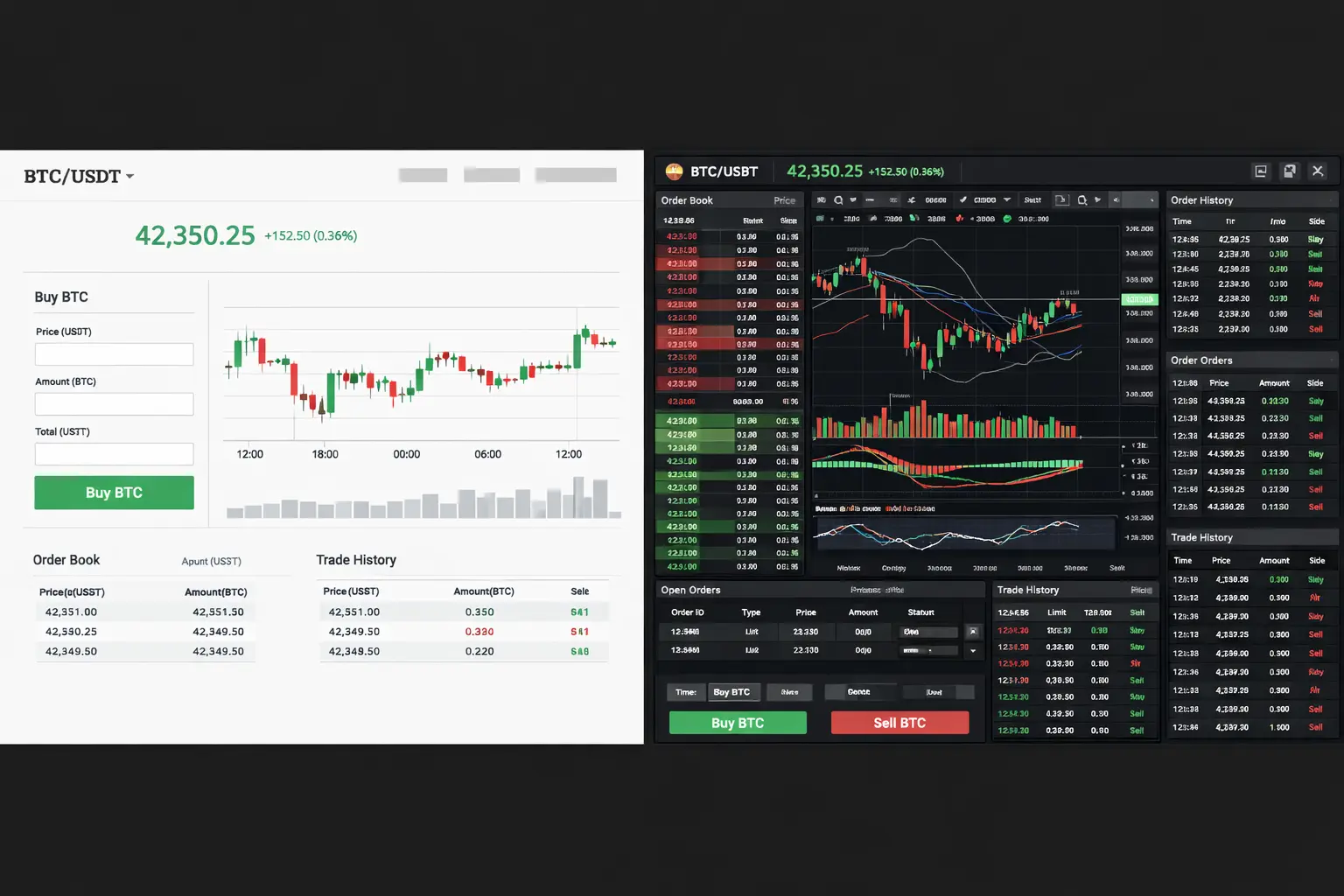
A trading terminal is the upgrade from a standard exchange web interface. Most retail traders start on an exchange’s default UI because it ships with the account. That interface covers the minimum: a price chart, a basic order form, and your balance. Terminals go further, designed specifically for active use across multiple markets simultaneously.
What separates a terminal from a standard exchange UI:
- ⚡ Advanced order types: stop-limit, trailing stop, iceberg orders, and conditional orders triggered by price or indicator levels
- 🌐 Multi-exchange view: monitor and execute across Binance, Kraken, Coinbase, and others from a single screen
- 📊 Level 2 order book: full depth-of-book visibility, not just the last traded price
- ⌨️ Hotkey execution: keyboard shortcuts for instant order placement without mouse interaction
- 🔔 Integrated alerts: price, volume, and indicator triggers that fire in real time
Trader and educator Anton Kreil, who ran a global macro desk at Goldman Sachs before moving to independent trading, runs all execution through a professional terminal setup rather than any single exchange interface. In his public course material he describes separating charting, order entry, and risk tracking into distinct panels so each function is visible simultaneously without switching screens. The principle applies at any scale: fragmented tools create lag and missed entries. A terminal collapses that into 1 view.
Telegram-based terminals
Telegram trading bots FAST are a distinct category because they solve a different problem: speed and accessibility on mobile. A Telegram terminal lets you execute trades via simple chat commands from your phone anywhere, at any time. For sniper strategies and token launches where the execution window is a few seconds, a Telegram interface with a fast RPC connection can make a measurable difference. Many active DeFi traders use Telegram terminals as their primary execution layer with chart analysis happening on a separate screen.
If you want to understand how the best Telegram-based tools approach this, the AI crypto trading bot review covers how modern bots handle speed, routing, and execution across chains in more detail.
Trading APIs: How Automation Connects to Markets
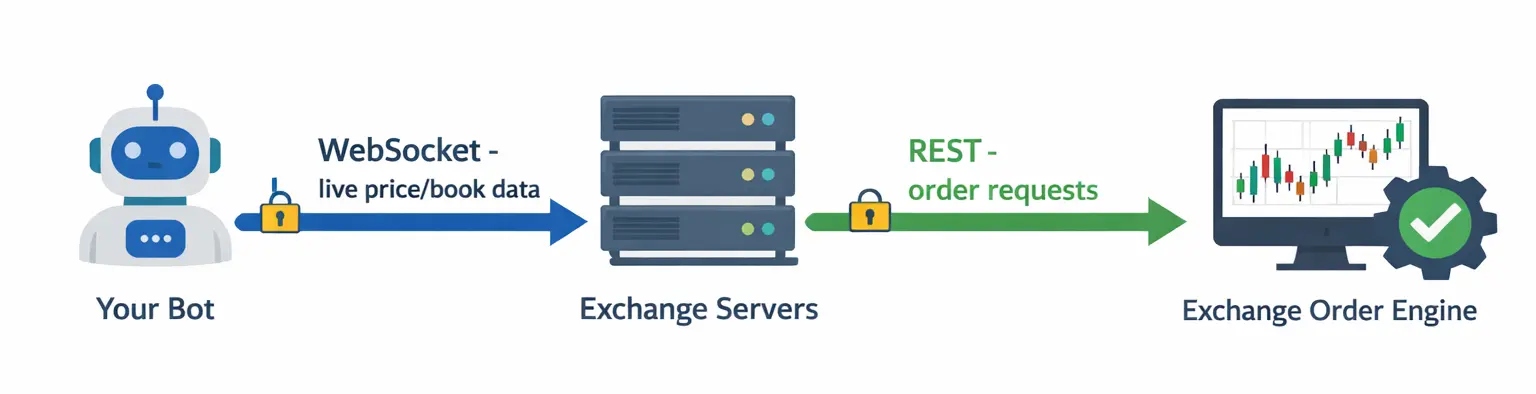
Every automated trading system relies on a trading API at its core. An exchange API is a set of rules and endpoints that let your code communicate with the exchange’s servers. Instead of clicking buttons on a website, your program sends structured requests and receives structured responses. A typical exchange API lets you do everything you can do manually: check prices, read balances, place orders, cancel orders, and retrieve trade history.
REST vs. WebSocket
Exchange APIs generally offer 2 connection models. REST: your code sends a request and waits for a response. Good for placing orders and fetching snapshots of data. Each request is independent. WebSocket: a persistent two-way connection where the exchange pushes data to your program the moment it changes. Essential for real-time price feeds, order book updates, and live trade flow. For most bot strategies, you use both: WebSocket to receive live market data, REST to place and manage orders.
Authentication and rate limits
Most exchange APIs use API key authentication. You generate a key pair in your exchange account settings and pass the public key in every request header. The secret key signs requests cryptographically and should never be shared or hardcoded in public repositories. Rate limits define how many requests you can make per second or minute. Exceeding them results in temporary IP bans. Design your bot to stay well below the limit, especially during volatile periods when request volume spikes.
| Exchange | WebSocket | Spot + Futures | Rate Limit |
|---|---|---|---|
| Binance | Yes | Yes | 1,200 req/min |
| Coinbase Adv. | Yes | Spot only | 30 req/sec |
| Kraken | Yes | Yes | 60 req/min |
| Bybit | Yes | Yes | 600 req/min |
| OKX | Yes | Yes | 600 req/min |
The ccxt library (CryptoCurrency eXchange Trading) provides a unified interface to over 100 exchanges. It abstracts away the differences between exchange APIs so 1 codebase runs across multiple platforms. Here is a basic authenticated call in Python using ccxt:
import ccxt

exchange = ccxt.binance({
    'apiKey': 'YOUR_API_KEY',
    'secret': 'YOUR_SECRET_KEY',
})

# Fetch available USDT balance
balance = exchange.fetch_balance()
print(balance['USDT']['free'])

# Place a market buy for 0.01 BTC
order = exchange.create_market_buy_order('BTC/USDT', 0.01)
print(order)
Three Arrows Capital, before its 2022 collapse, ran simultaneous positions across Deribit, BitMEX, FTX, and Binance. Their infrastructure relied on unified API access to manage cross-exchange delta exposure in real time, as documented in The Block’s reporting and liquidation court filings. The operational lesson is practical at any scale: managing positions across more than 1 exchange without API-based aggregation means always working with stale or incomplete information.
Build a Crypto Trading Bot: Step by Step
A trading bot is a program that follows a defined set of rules: read data, evaluate conditions, act if conditions are met, manage risk. The complexity comes from how sophisticated those rules are, and how reliably the system executes them under real market conditions.
The 4-layer architecture
- 📡 Data layer: connects to exchange APIs via WebSocket and REST to receive price data, order book updates, and account information in real time
- 🧠 Signal layer: applies your strategy logic to incoming data to generate buy or sell signals
- ⚙️ Execution layer: translates signals into actual orders, handles placement, confirmation, partial fills, and cancellations
- 🛡️ Risk management layer: enforces position limits, stop-losses, maximum daily drawdown, and controls that prevent a bug or bad signal from causing outsized loss
Most beginner bots skip or underbuild the 4th layer. This is the most common reason bots cause significant account damage. A signal that fires incorrectly on bad data, without a hard stop on position size or daily loss, can do in minutes what would take weeks manually.
| Framework | Setup | Backtesting | Best For |
|---|---|---|---|
| Freqtrade | Low to medium | Built-in | Trend / signal bots |
| Hummingbot | Medium | Limited | Market making |
| Custom Python | High | Manual build | Custom logic |
For a first bot, Freqtrade is the recommended starting point. It handles infrastructure (data feeds, order management, risk controls, logging, backtesting) so you focus on strategy logic. Custom builds make sense when you have requirements those frameworks cannot meet. Here is a minimal strategy in Freqtrade using RSI:
from freqtrade.strategy import IStrategy
import talib.abstract as ta

class RSIStrategy(IStrategy):
    timeframe = '1h'
    stoploss = -0.05   # 5% max loss per trade

    def populate_indicators(self, df, metadata):
        df['rsi'] = ta.RSI(df, timeperiod=14)
        return df

    def populate_entry_trend(self, df, metadata):
        df.loc[df['rsi'] < 30, 'enter_long'] = 1
        return df

    def populate_exit_trend(self, df, metadata):
        df.loc[df['rsi'] > 70, 'exit_long'] = 1
        return df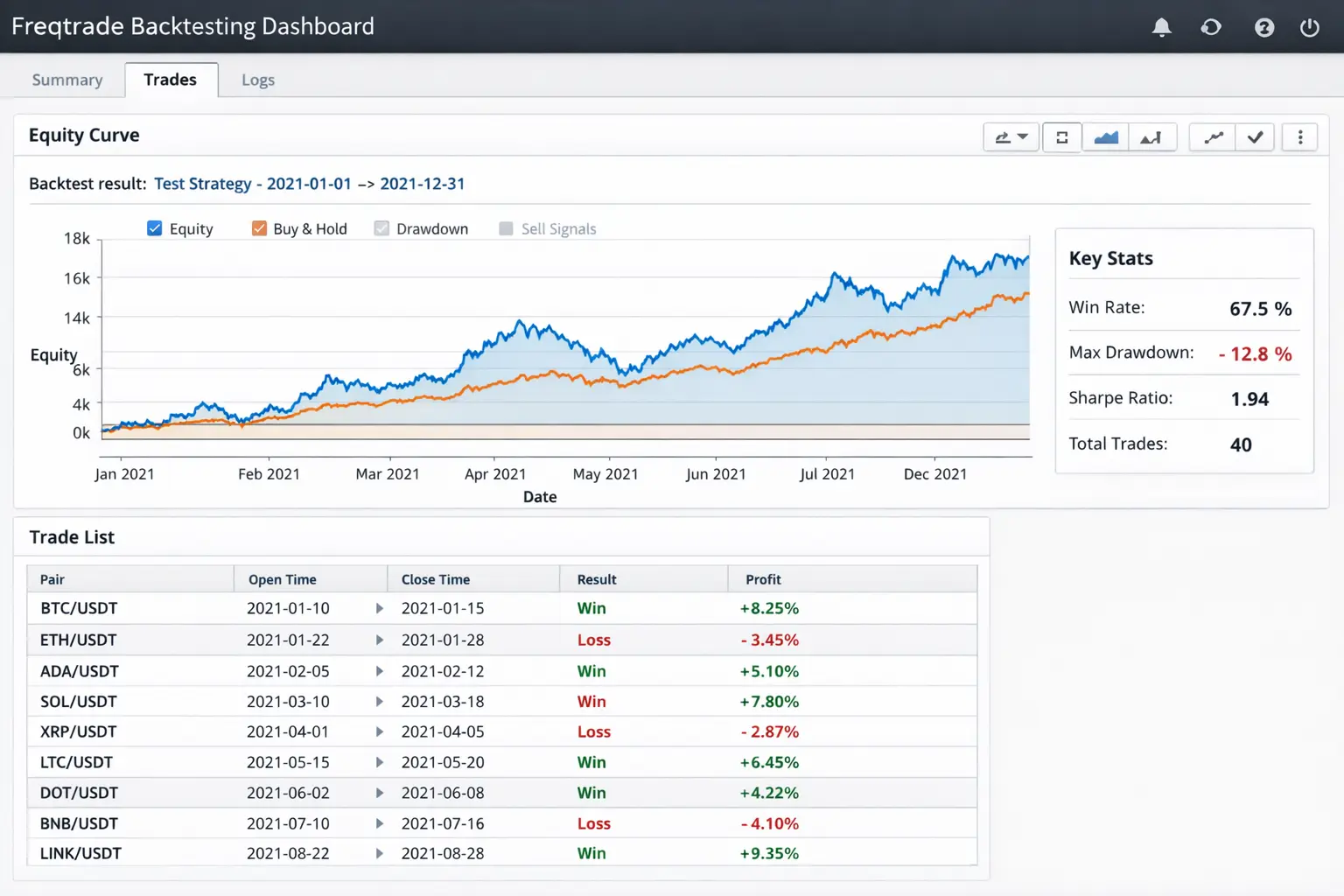
This strategy enters long when RSI drops below 30 and exits above 70. Production strategies layer multiple confirmation signals before acting and include dynamic position sizing based on volatility. The example exists to show structure, not to be deployed directly.
The testing hierarchy you should not skip
Backtesting runs your strategy against historical data. Watch for overfitting: a strategy tuned to one dataset often fails on new data. Paper trading runs the strategy live with simulated capital and catches API errors, timing issues, and edge cases that never appear in historical tests. Live trading with minimal capital comes only after successful paper trading. Treat the first 4 weeks as paid testing, not production.
Wintermute Trading, one of the largest algorithmic crypto trading firms by volume, has described their process in podcast appearances and hiring materials. They start every strategy with a hypothesis grounded in market microstructure, not curve-fitting. They backtest across multiple market regimes. They paper trade in parallel with live positions when deploying something new. And they track live performance against backtest expectations daily. If live performance deviates significantly, the strategy is paused until the cause is understood.
Sniper Trading and Sniper Bots
Sniper trading means precision timing: entering or exiting at a specific moment with maximum speed and minimal slippage. In crypto, the term covers 2 different contexts that require completely different approaches.
Context 1: Token launch sniping on DEXs
On decentralized exchanges like Uniswap or PancakeSwap, a new token listing creates a brief window where early buyers can acquire tokens before price moves. A sniper bot monitors the blockchain’s pending transaction pool (the mempool) for the liquidity-add transaction that signals a new token is being listed. When that transaction confirms, the bot buys in the same block or the one immediately after.
This requires a private or dedicated RPC node because public nodes introduce latency that loses the snipe to faster bots. It also requires pre-approved token contracts, since sending an approval transaction in the same block as the buy adds delay. Gas management matters too: either pay a higher gas price to be included earlier, or use a private mempool service like Flashbots to avoid being frontrun by other bots. Before any snipe, simulate a sell transaction against the contract. Honeypot contracts allow buying but block selling entirely.
Context 2: Price-level sniping
Outside DeFi launches, sniper trading simply means executing precisely at a target level. A trader sets a limit entry just below a key support zone, or a buy order that triggers the moment a resistance level breaks on a confirmed candle close, rather than chasing price after the move is already several percent underway. In this context, a fast Telegram trading terminal functions as a sniper tool, putting execution 1 tap away on mobile with fast order routing.
Risks specific to sniper strategies
- 🪤 Rug pulls and honeypots: a significant share of new token launches are scams. The Chainalysis Crypto Crime Report documented that rug pulls represent the majority of DeFi scam revenue. Always simulate the sell before buying.
- ⛽ Gas wars: when multiple bots target the same launch, the one with the highest gas price wins the block position. This drives up cost and sometimes makes the snipe unprofitable even if it executes.
- 🥪 MEV (Maximal Extractable Value): block proposers can reorder pending transactions to sandwich your trade. Flashbots Protect routes transactions privately to avoid this.
- ⚖️ Regulatory exposure: automated high-frequency trading has reporting requirements in many jurisdictions. Verify the rules that apply to your location before deploying.
Banana Gun and Maestro are 2 widely used Telegram-based sniper bots that illustrate both the scale and the risk of this approach. In September 2023, Banana Gun suffered an exploit that drained approximately $1.9 million from user wallets due to a smart contract vulnerability, documented by multiple on-chain analysts and confirmed by the team. Maestro had a similar incident in October 2023. Both teams refunded affected users and patched the contracts. The practical lesson: when using any third-party sniper bot, understand what permissions the contract holds over your wallet before connecting. Profitable token-launch sniping is dominated by bots with infrastructure advantages (private nodes, co-located servers, dedicated block builders) that are expensive to replicate individually. Price-level sniping using a fast execution terminal is more accessible and carries less counterparty risk.
Market Making as an Automated Strategy
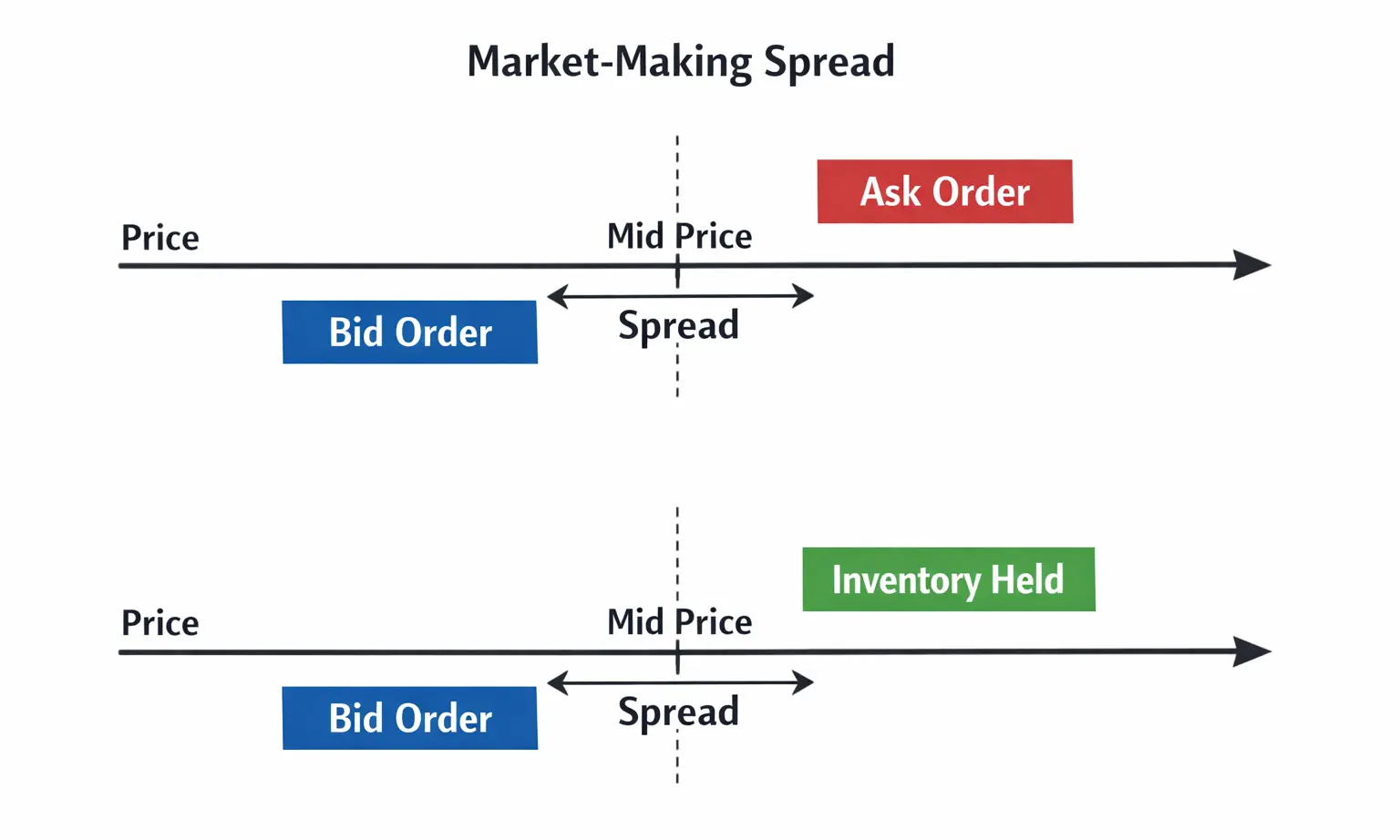
Market making is one of the most consistently applied strategies in trading across every asset class. It is also one that is almost impossible to run manually at any meaningful scale, which makes it a natural fit for automation.
A market maker simultaneously posts a buy order (bid) below the current price and a sell order (ask) above it. The difference between the 2 is the spread, which is the gross profit per completed round trip when both sides fill. The trade-off is inventory risk: if price moves strongly in one direction, the market maker ends up holding a declining asset or has an unfilled order on the other side.
How automated market making works
- 📈 Fetch mid-price: pull the current mid-price from the live order book on every cycle
- 📐 Calculate spread: place bid and ask at configurable distances around the mid
- 🔄 Monitor fills: when one side fills, adjust or refresh both sides immediately
- ⚖️ Manage inventory: if one side fills repeatedly and directional exposure builds, widen the spread or pause quoting until the position rebalances
Institutional market makers operate with tight spreads and high frequency on the most liquid pairs. Retail traders competing directly on BTC/USDT or ETH/USDT will face consistent losses to faster, better-capitalized bots. Where retail market making can work: low-competition altcoin pairs with naturally wide spreads, DEX liquidity provision on Uniswap v3 or similar concentrated liquidity AMMs (impermanent loss is the primary risk and must be modeled before committing capital), and range-bound markets where price oscillates within a defined band rather than trending with momentum.
GSR Markets is one of the largest crypto market makers and has published their approach in industry interviews. They describe running tight spreads on high-volume pairs while accepting wider spreads on less liquid tokens to compensate for inventory risk. They adjust spread width dynamically based on realized volatility: when a token becomes volatile, spreads widen automatically to protect against being picked off by directional traders who have information the market maker does not. Individual traders using Hummingbot can replicate this logic at small scale using the pure market making strategy with volatility-based spread adjustment enabled.
Choosing Your Automation Stack
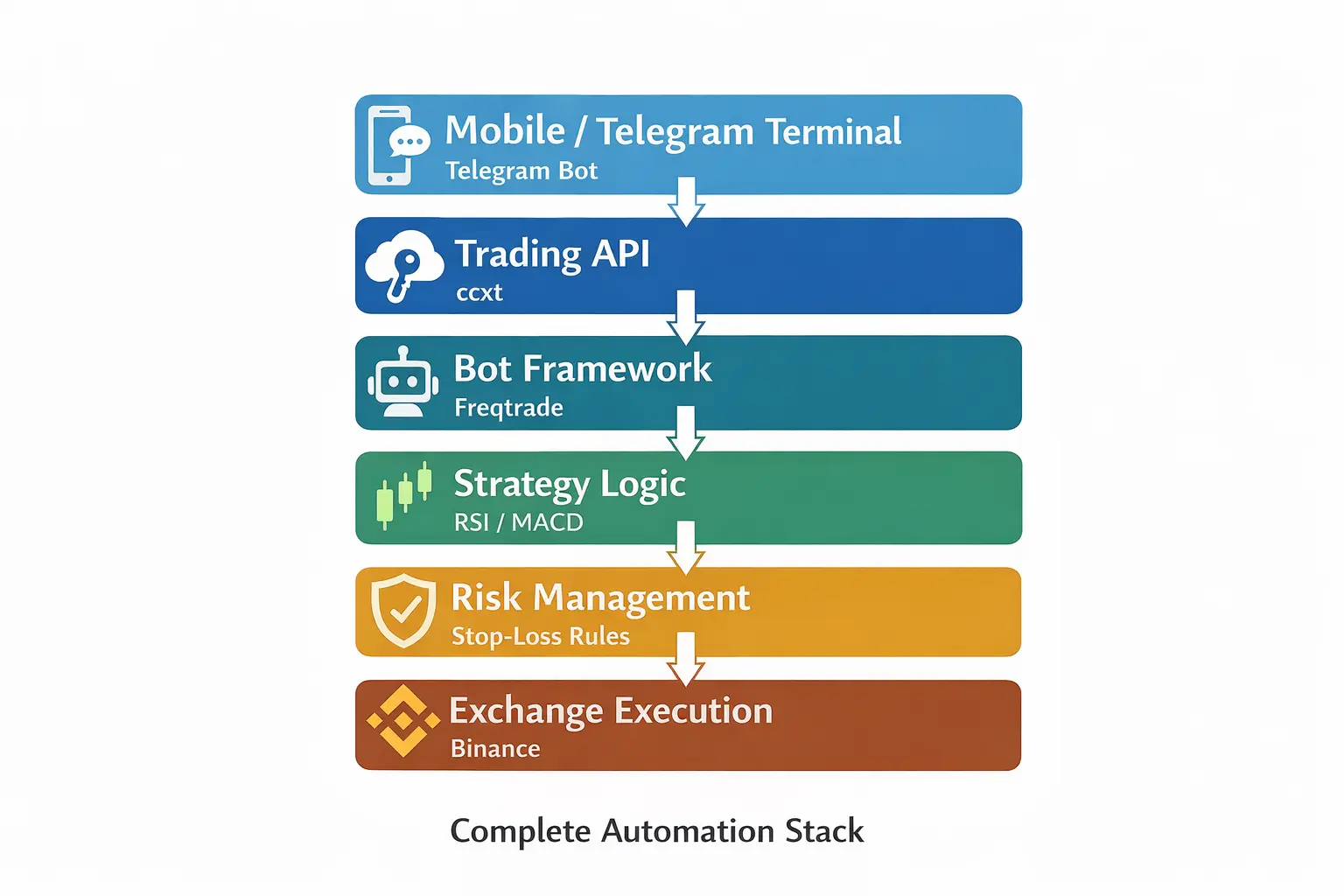
The right setup depends on what you are trading, how much capital you are deploying, and how much engineering you are willing to do. The table below maps trader profiles to concrete tool recommendations.
| Profile | Recommended Tools | Starting Point |
|---|---|---|
| Active manual trader | Telegram terminalTradingView alerts | Move execution to Telegram first |
| Systematic trader | FreqtradeccxtExchange API | Backtest, paper trade 30 days |
| DeFi / sniper trader | Telegram sniper botPrivate RPC node | Price-level before mempool |
| Market maker | HummingbotBinance or DEX AMM | Single pair, wide spread |
| Developer / quant | Custom PythonccxtPostgreSQL | Data pipeline first |
Pre-launch checklist
Before deploying any bot with real capital, verify each of the following. API keys use minimum required permissions (read and trade only, no withdrawal access). Keys are stored in environment variables, not hardcoded in source code or version control. The strategy has been backtested on at least 12 months of historical data across different market conditions. Paper trading results are satisfactory over a minimum of 3 weeks. Maximum position size and daily loss limits are explicitly coded, not just intended. Monitoring is active so you receive an alert immediately if the bot stops, throws an error, or hits its loss limit. And you have tested a kill switch that cancels all open orders immediately.
Jump Crypto, the digital assets arm of Jump Trading, has described their engineering approach in hiring documentation and conference talks. They run every trading system through 3 environments before live capital: development, staging with real market data but simulated execution, and production with controlled position limits that expand as the system proves stable. They treat the first 30 days of live trading as a validation period, not a performance period. Applying the same phased approach with Freqtrade or a Telegram terminal is the single best risk control available to individual traders.
Is Crypto Trading Automation Right for You?
Automation is not a replacement for strategy. It is a way to execute a well-defined approach consistently, without the reaction time limits and emotional interference that affect manual trading. A sound strategy, automated well, runs while you sleep and follows its rules without deviation. The tools covered in this guide (Freqtrade, Hummingbot, ccxt, and Telegram-based terminals) were all unavailable or inaccessible to retail traders 5 years ago. Today they are open source and well-documented.
The practical starting point for most traders is narrower than this guide might suggest: pick 1 strategy, 1 exchange, 1 framework. Backtest it. Paper trade it. Deploy it with capital you can lose completely. Iterate from there. The traders who build reliable automated systems are almost always the ones who started with something simple and understood it deeply, not the ones who launched immediately with a complex multi-signal, multi-exchange setup. A Telegram-based trading terminal that removes the desktop dependency is a logical first step for anyone who wants fast, mobile-accessible execution without the engineering overhead of a full bot build.
Frequently Asked Questions
You need an exchange account with API access, a programming environment (Python is the most common choice), a bot framework like Freqtrade or Hummingbot, and a defined strategy with clear entry, exit, and risk rules. A basic cloud server (VPS) keeps the bot running 24/7 without depending on your local machine.
Yes, for most individual traders. Python has the best library support for crypto automation: ccxt for exchange connectivity, pandas and TA-Lib for technical analysis, and Freqtrade as a production-ready framework. JavaScript and Go are used in institutional contexts for low-latency execution, but Python covers the vast majority of retail use cases effectively.
Freqtrade paired with the Binance or Bybit API is the most documented combination for systematic traders. For Solana DeFi, Telegram-based terminals using Jupiter or Raydium routing with private RPC nodes give the best execution speed. TradingView for chart signals combined with a bot that accepts webhook alerts is effective for signal-based strategies without custom indicator coding.
Some do, consistently, but the majority of retail bots deployed without rigorous backtesting and risk controls lose capital. A bot executes a strategy mechanically: if the strategy has an edge, the bot captures it reliably. If it does not, the bot loses faster than manual trading. Backtest results do not guarantee live performance across different market conditions.
A DEX sniper bot monitors the blockchain mempool for liquidity-add transactions that signal a new token listing. When that transaction confirms, the bot submits a buy in the same or immediately following block. Speed depends on RPC node quality, gas settings, and whether the transaction uses private routing to avoid MEV frontrunning. Always simulate a sell against the contract before buying to detect honeypots.
Freqtrade is a well-maintained open-source framework used by thousands of traders. The framework itself is not a risk. The risk is in the strategy you run and how you configure position sizing and stop-losses. Use API keys with trade-only permissions (no withdrawal access), run paper trading for at least 3 weeks, and set hard daily loss limits before any live deployment.
Resources