
AI agents vs trading bots: rules versus judgment
A trading bot executes rules you set; an AI trading agent interprets live data and adapts its decisions. Miss a launch by four seconds and the entry is already 40% higher: that's the problem bots solve. But when a celebrity post moves a token, or a Whale quietly accumulates, a fixed-rule bot sees nothing. That's the gap agents fill.

| Trading bot | AI trading agent | |
|---|---|---|
| Data inputs | Price and volume | Price, on-chain, social and news |
| Speed | Milliseconds | Seconds to minutes |
| Adaptability | Fixed rules | Learns from live data |
| Cost | Usually a per-trade fee | Usually a subscription |
| Best for | Sniping, DCA, arbitrage, limit orders | Trend reading, adaptive risk, sentiment |
Each has a failure mode. A badly configured bot loses money as mechanically as a good one makes it. An agent depends on its data: bad feeds mean bad calls. MIT Sloan's explainer on agentic AI covers how these systems reason in general.
When an AI agent wins, and when a bot does
Bots are faster; agents read more context. Neither replaces the other in a serious workflow.
- ⚡ Use a bot for instant execution, repeatable strategies and memecoin sniping.
- 🧠 Use an agent for trend reading, adaptive stop-losses and filtering real hype from noise.
- 🔗 Use both when you want the signal and the speed in the same trade.
The workflow most traders overlook: let the agent scan and surface signals, then let an execution bot fire them on-chain at once. Our copy trading comparison shows the execution side for Solana. For the research angle, this arXiv paper looks at what happens when AI agents get direct access to crypto and smart contracts.
AI trading platforms: 3Commas, Cryptohopper and TradeSanta
Three platforms bring AI-assisted automation to centralized exchanges. Our full comparison of 3Commas, Cryptohopper and TradeSanta covers pricing and setup; here's what each brings on the agent side.

Cryptohopper (since 2017, 1M+ users, 9M+ transactions) lets you build logic yourself in a no-code Strategy Designer with 130+ indicators, then an AI trading module adapts the parameters to live conditions. It adds a real cross-exchange arbitrage bot and paper trading on live market data. Higher tiers cost real money, so the arbitrage feature has to earn the upgrade.


3Commas (since 2017, 1M+ users, $400B+ volume) leans into autonomy with QuantPilot, an AI agent that builds, backtests and optimizes full strategies. It connects to 20+ exchanges, including Binance, Bybit, OKX, Kraken and Coinbase, and funds stay on your exchange. The subscription adds up on small accounts.

TradeSanta (since 2018) is the simple entry point: cloud-based DCA and Grid bots on Binance and OKX, a mobile app and Telegram alerts, priced below both rivals. Only six exchanges, and trailing take-profit plus TradingView signals sit behind higher tiers.
On-chain execution bots: Trojan, MevX and Maestro
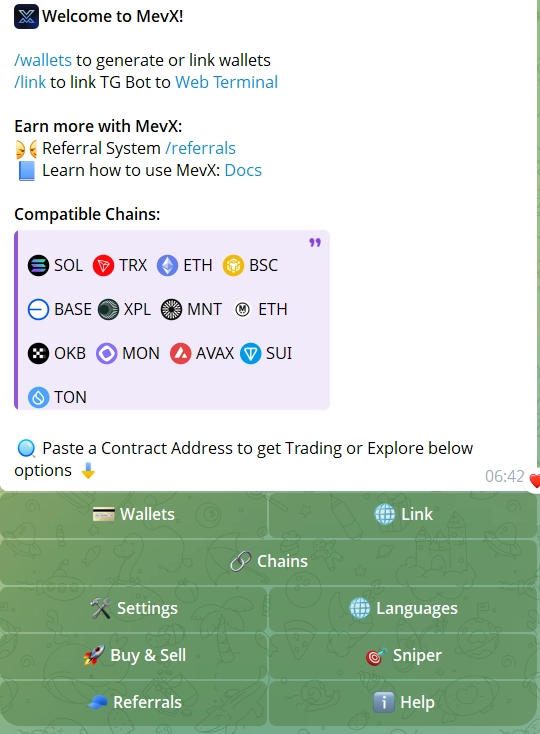
For DEX trading, where seconds separate a 2x from break-even, you need purpose-built execution bots. All three below run inside Telegram.
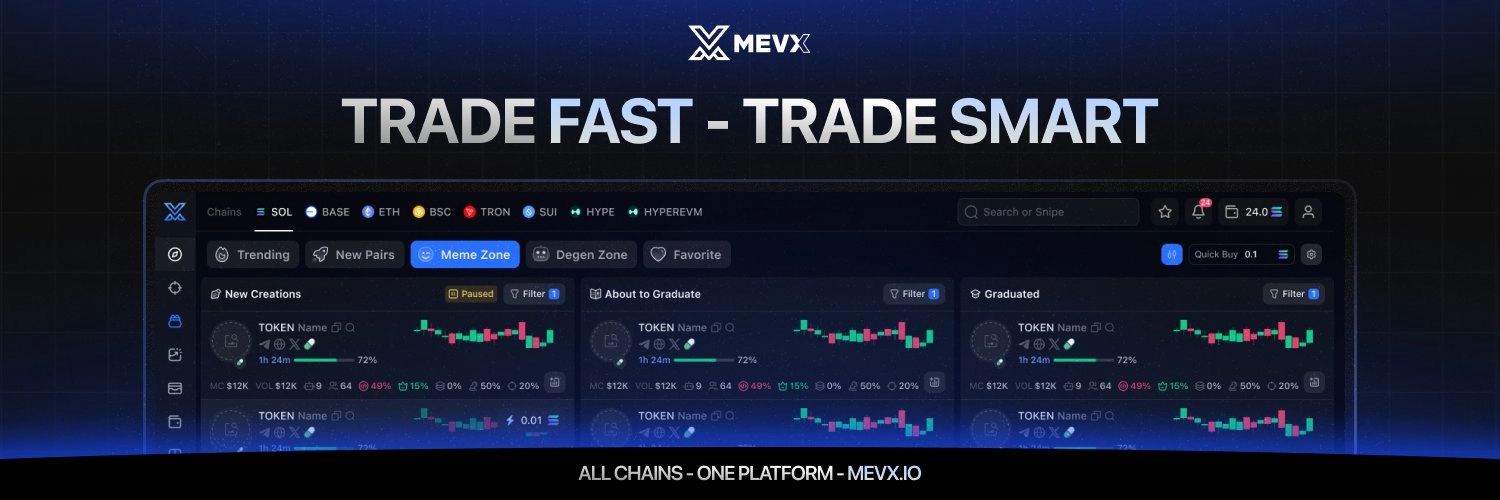
- MevX: launched May 2024, $30M+ revenue and $700M+ volume in its first year, top 10 on DeFiLlama by fees. Six chains, 0.5% on BSC, web app, Telegram bot and Chrome extension. Always start from mevx.io: fake copies circulate.
- Maestro: running since 2022, 573,000+ users and $12.8B+ volume across 15 chains. Patented Anti-Rug designed to exit before a rug, blacklist or mint executes; Telegram only, Premium at $200 a month.
- Trojan: the Solana specialist, sub-2-second BOLT execution, copy trading and a web terminal.

Three ways to combine an AI agent with a trading bot
Consistent traders don't pick sides; they give each tool the part of the trade where it wins.
- Sniping a new launch: bot only. A memecoin launches in minutes, and there's no history for an agent to analyze. A sniper like Maestro or MevX buys the instant liquidity appears, anti-rug filters screen the contract, and a take-profit exits before sentiment fades.
- Riding sentiment: agent, then bot. A celebrity post starts lifting a token. An agent such as Cryptohopper or 3Commas scans social engagement, Whale activity and volume acceleration together; when signals line up, a bot executes immediately. The agent alone is too slow, the bot alone can't tell signal from noise.
- Protecting altcoins in a downturn: adaptive exits. A fixed stop-loss fires the same way on a flash crash and on real capitulation. An adaptive setup, such as TradeSanta's volatility-based exits, reacts differently to a coordinated Whale sell-off or a liquidity drain than to a normal retrace. Prefer control? Run alert-only: the system flags danger, you decide.
Neither tool guarantees returns. Size positions for what you can lose, and test any new automation small first; Liora's overview of crypto AI agents is a useful primer on the agent side.