
You set a buy at $0.0042, the token dips to $0.0031 the next morning, and suddenly your single entry looks terrible. That is not bad luck; it is the cost of timing a market that does not care about your schedule. Crypto DCA bots solve this by spreading entries automatically, so no single bad moment wrecks the position. This guide covers how the strategy actually works, why Trojan is the sharper tool for Solana, and when MEVx makes more sense if you trade across multiple chains. Read our bot testing process.
Key Takeaways
- DCA spreads your buys over time, lowering your average entry price.
- Trojan on Solana supports configurable DCA with sub-2-second execution.
- MEVx offers DCA across 6 chains including Solana, ETH, BSC, and Base.
- Always check token safety on RugCheck before setting up any DCA strategy.
What Is Dollar-Cost Averaging in Crypto?
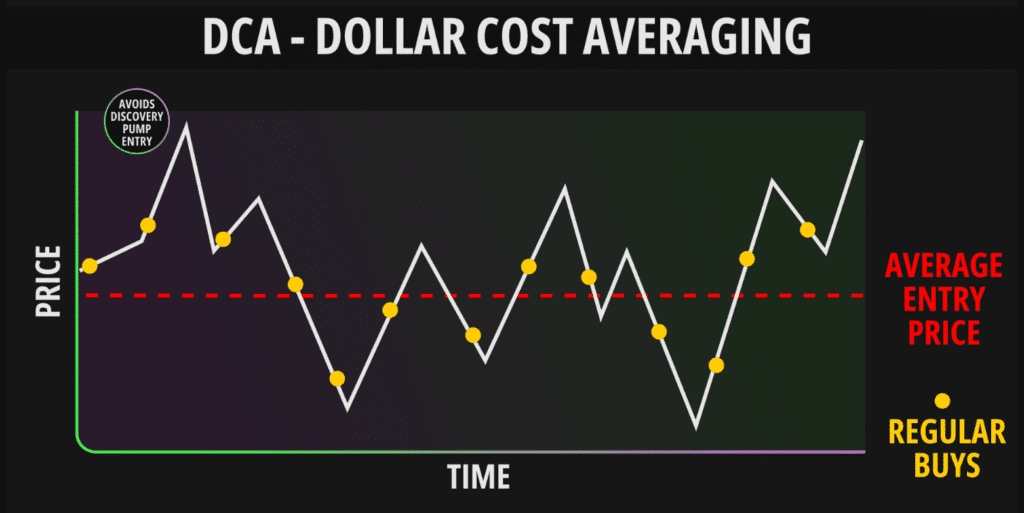
Say you have $1,000 to put into a new Solana meme coin. Instead of going all in and hoping the timing holds, you split it into ten $100 buys spaced a day apart. Some buys land high, some catch a dip. After ten days, your average cost sits somewhere in the middle, and you never had to predict which day was the right one.
The automation piece is what the DCA trading bot crypto space is really about. A bot places each scheduled buy without your involvement, routes it cleanly, and logs the fill. The strategy is not new; removing human hesitation from execution is the actual value.
Why DCA Works So Well with Crypto Bots
Manual DCA falls apart the moment something happens while you are offline. A liquidity event, a migration, a sudden volume spike; your scheduled buy needs to execute right then, not ten minutes later when you notice the notification. A sniper bot does not hesitate. It fires on the configured parameters the instant the interval triggers.
Pairing DCA with a Solana sniper bot gives you risk management from spread entries and execution speed from automated sniping at the same time. The bot routes through MEV protection, logs the position, and moves on. No chart watching needed once it is configured.
The less-discussed benefit is FOMO resistance. When a coin is moving fast and the urge to oversize is strong, the bot keeps running at the same cadence. That preset discipline is harder to maintain manually than most traders admit.
Trojan on Solana: Speed First, Strategy Second
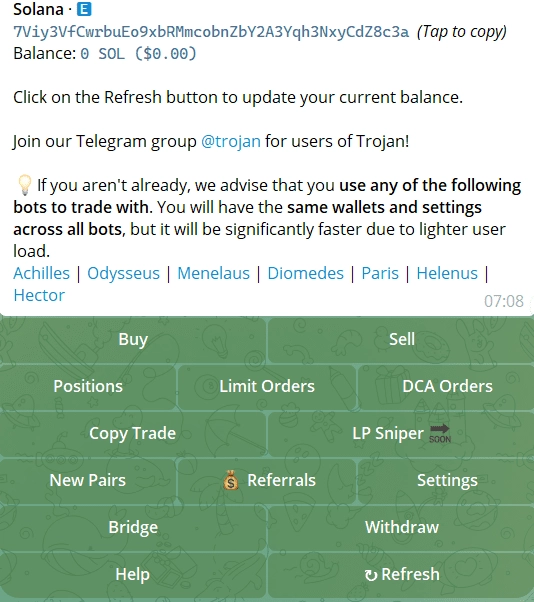
Trojan is the largest Solana trading platform by volume, with over $25B traded and 2M+ users. It runs as both a Telegram bot and a full web terminal at trojan.com/terminal. The defining feature for DCA is BOLT technology: sub-2-second execution that holds up even during migration events and launch windows when the chain is under load. You configure amount per buy, interval, and total duration, and BOLT handles the timing precisely.
One thing worth knowing: BOLT Pro mode requires a 50+ SOL wallet balance. If you are starting smaller, standard execution is still fast, but you will not unlock the priority routing tier. For most DCA campaigns on mid-cap tokens, standard mode is fine.
- 📈 DCA Orders: Set your interval, total duration, and amount per buy. Trojan handles the rest automatically.
- ⚡ BOLT Execution: Sub-2-second fills mean your DCA buys land even in volatile, high-traffic conditions.
- 👥 Copy Trading: Follow profitable wallets automatically while your DCA runs in parallel.
- 🎯 Limit Orders with TP/SL: Attach take-profit and stop-loss to any position, including DCA-entered ones.
- 🛡️ MEV Protection via JITO: Transactions route privately to prevent sandwich attacks on every buy.
- 🔄 Migration Sniper: Auto-triggers the instant a token moves off a bonding curve, timed perfectly with your DCA strategy.
- 🏆 Arena Cashback: Earn up to 45% cashback on trading fees through Trojan’s loyalty tier system, paid in SOL.
Trojan on Solana: Pros & Cons
- Fastest DCA execution on Solana with BOLT technology
- Full web terminal for advanced DCA management
- Up to 45% cashback on fees through the Arena system
- MEV protection on every transaction via JITO
- Solana only, no multi-chain token trading
- BOLT Pro mode requires a 50+ SOL wallet balance
Real-world example: You have $1,000 to put into a new Solana token. Set Trojan to buy $100 per day for 10 days. On day three, the price dips 10%. That scheduled buy captures more tokens at the lower price automatically. By day ten, your average cost per token reflects those cheaper fills, and you did nothing after the initial setup.
Ready to run this exact setup? Open Trojan on Solana and configure your first DCA order in under two minutes.
MEVx: When You Are Trading More Than Just Solana
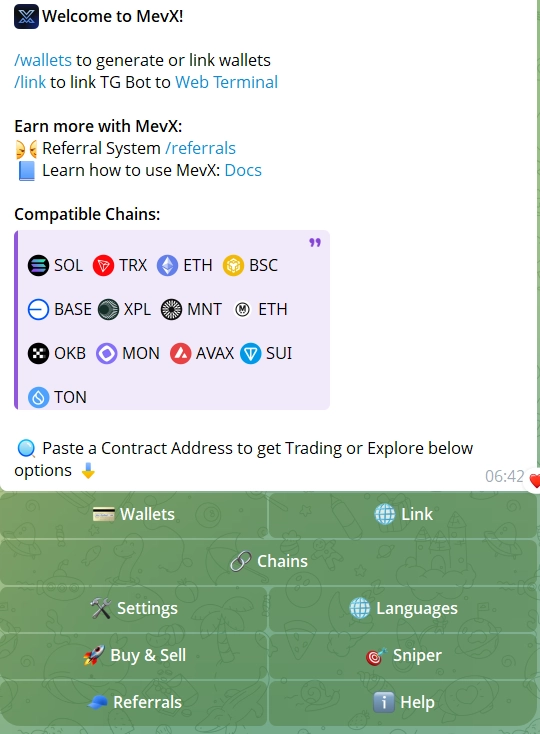
Trojan does one chain exceptionally well. MEVx does six. This Singapore-based platform covers Solana, Ethereum, BNB Chain, Base, Robinhood, and Monad, running across a web app, Telegram bot, and Chrome extension. Generated over $30M in revenue in 2024. The DCA feature works across all supported chains with configurable intervals, and the 0.5% fee on BSC becomes meaningful over longer campaigns where fees accumulate on every interval buy.
The standout feature is limit orders by market cap, not just price. You can set your DCA exit target at a specific market cap rather than a price point, which is far more useful on low-float tokens where price alone tells you little about actual size.
- 📈 DCA: Configurable interval and total amount across all 11 supported chains.
- 📊 Limit Orders by Market Cap: A genuinely unique feature. Set your DCA exit triggers by market cap target, not just price.
- 🫧 Bubble Maps: Visualize token holder distribution before you start a DCA campaign. Spot dangerous wallet clusters early.
- 🔥 Meme Zone and Degen Zone: Real-time trackers for emerging tokens across supported chains, helping you identify DCA targets.
- 🖥️ Chrome Extension: Trade and manage DCA positions directly from any chart or social feed in your browser.
- 📱 Trailing Stop Orders: Available on memecoins across all supported chains, protecting your DCA gains on the way out.
MEVx: Pros & Cons
- DCA available across 6 chains in one platform
- Low 0.5% fee on BSC, among the cheapest of any multi-chain bot
- Limit orders by market cap, not just price
- Web app, Telegram bot, and Chrome extension
- Triple-platform can feel fragmented vs. a focused single-interface tool
How to Set Up DCA with Trojan Bot
Check the Token First
Before setting up any DCA strategy, run the token contract through RugCheck.xyz to scan for red flags: unverified liquidity, large whale wallet concentrations, or mint functions that could tank your position. A DCA strategy only makes sense on a token with genuine traction and at least some roadmap or community behind it.
Open Trojan on Solana
Head to Telegram and launch the bot. Start Trojan here. First-time users get a new Solana wallet generated automatically. Fund it with SOL before moving forward, enough to cover the full DCA budget plus transaction fees for each scheduled buy.
Paste the Token Contract Address
Grab the contract address (CA) from DexScreener or the project’s official channel. Paste it directly into Trojan. The bot pulls up current price, liquidity, and a live safety audit. Verify the token details match what you intended before going further.
Configure Your DCA Parameters
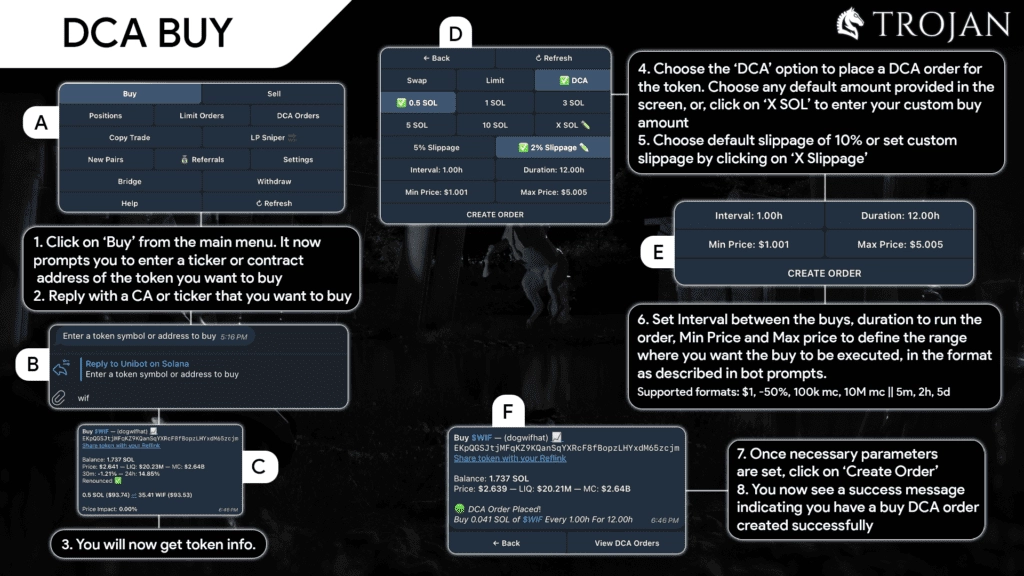
Select DCA Orders and set three inputs: amount per buy (e.g., $100 in SOL), interval (e.g., every 24 hours), and total duration (e.g., 10 days). Slippage tolerance matters here. For most meme coins, 2-5% slippage is a reasonable range. Too tight and you get missed fills; too wide and volatile prints cost you more than you would expect.
Set Your Exit Strategy
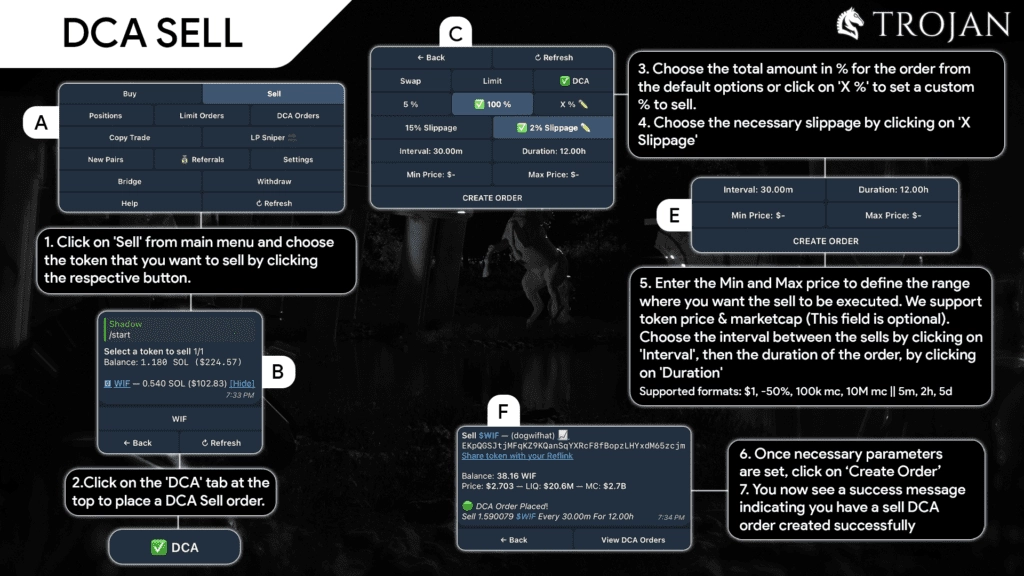
DCA handles entries. The exit needs equal thought. Use Trojan’s Limit Orders with Take Profit and Stop Loss to automate the other side before the campaign starts. A simple setup: take profit at 2x average entry, stop loss at 25% below. Both sides automated means you do not need to watch the chart at all once it is running.
Monitor and Adjust
Trojan’s Token Analytics panel shows top holders, wallet activity, and on-chain history in real time. Check in every few days, not every hour. If a whale starts offloading or community engagement drops sharply, you can pause or cancel remaining orders before they execute. The DCA strategy works best when you stay loosely aware without micromanaging every buy.
Good Candidates for DCA, and Tokens to Skip Entirely
DCA earns its place on tokens with growing communities, active development, and consistent on-chain volume. Meme coins with real Telegram activity, regular project updates, or meaningful holder growth reward patience. The spread of entries over time protects against buying at the worst possible moment, which is usually the moment you are most excited.
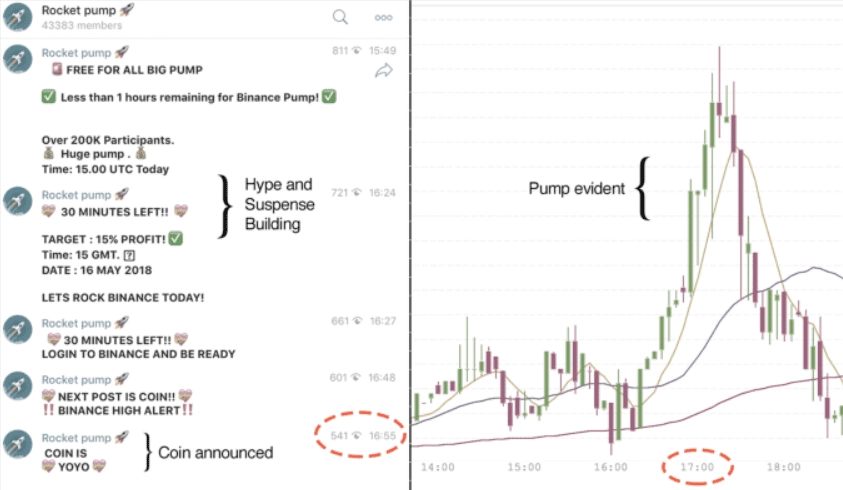
Skip DCA on anything that doubled overnight on Twitter noise with no roadmap and unlocked liquidity. These tokens do not grow over time; they dump once the early buyers exit. Running DCA into a rug just means you lose money in smaller, more evenly spaced increments. If RugCheck returns multiple red flags, walk away regardless of how good the chart looked ten minutes ago.
Tips for DCA Success
- 💡 Size your positions correctly: Never DCA more into a single token than you can afford to lose entirely. Spread risk across multiple positions rather than going deep on one.
- 📊 Use DexScreener for market cap context: Watch volume and liquidity trends alongside your DCA. A token losing liquidity while you are mid-campaign is a signal to reassess.
- ⏱️ Match your interval to the token’s volatility: High-volatility meme coins benefit from shorter intervals, daily or every few hours. More stable mid-cap tokens can tolerate weekly buys.
- 🛡️ Always scan first on RugCheck: Make this a habit before any DCA setup. Catching a honeypot or mint-function risk before you start saves your whole budget.
- 🎯 Pair DCA with Copy Trading on Trojan: Running copy trading alongside a DCA position lets you observe how smart money is moving on the same token, and gives you an early signal if the thesis is changing.
- 🔄 Don’t FOMO-extend a campaign: If your DCA completes its planned duration, evaluate the position fresh. Extending purely because the price is up is a separate decision that deserves the same analysis as the original one.
Frequently Asked Questions
Trojan on Solana is the strongest option for Solana-specific DCA. The BOLT execution layer keeps fills landing under two seconds even when the network is busy, which matters during token launches and migration events that would cause a slower bot to miss its interval window. The Arena cashback system, which returns up to 45% of fees in SOL, meaningfully reduces the cost of longer campaigns.
You set three parameters: amount per buy, interval between buys, and total campaign duration. The bot executes each order automatically at the configured time, with no manual input required. Execution speed matters more than most people expect here; a bot that takes five seconds to confirm during a volatile window may fill at a worse price than one that confirms in under two seconds.
Yes, and it tends to outperform single-entry sniping on meme coins that have genuine staying power. The risk is selecting the right tokens: DCA reduces bad-timing risk but cannot recover a position on a token with no liquidity or a compromised contract. Always run a RugCheck scan first, and set a stop-loss on day one so the exit is automated if the thesis breaks.
MEVx covers 6 chains: Solana, Ethereum, BNB Chain, Base, Robinhood, and Monad. The 0.5% fee on BSC is the practical differentiator for multi-chain DCA; over a 20-buy campaign, fee savings on that chain add up more than most traders calculate upfront.
Token selection is the biggest variable: DCA on a bad project just distributes the loss more evenly. Beyond that, run RugCheck before starting, set automated take-profit and stop-loss orders on Trojan so both sides are handled, and keep each position sized so a full loss does not damage your overall portfolio. Monitoring holder concentration through the campaign catches whale exit signals before they hit price.
DexScreener covers price action, volume trends, and liquidity depth in real time. For Solana specifically, Trojan’s Token Analytics panel adds on-chain holder data and wallet movement history, which is more useful for catching early red flags than price alone. Checking both every two or three days during an active campaign is enough; daily monitoring tends to produce emotional decisions more than it produces useful ones.
Resources